Make Patching
Fun Again.
Transform the daily struggle of plugging into a joyful game your child asks to play. Piggy Peekaboo turns patching time into an engaging adventure your child looks forward to.


Transform the daily struggle of plugging into a joyful game your child asks to play. Piggy Peekaboo turns patching time into an engaging adventure your child looks forward to.
Every game is unique. AI generates new hiding spots each time, keeping the challenge fresh.
Hand-drawn visuals and soothing sounds create a stress-free environment for daily practice.
No downloads needed. Play directly in your browser on any device - tablet, phone, or desktop.
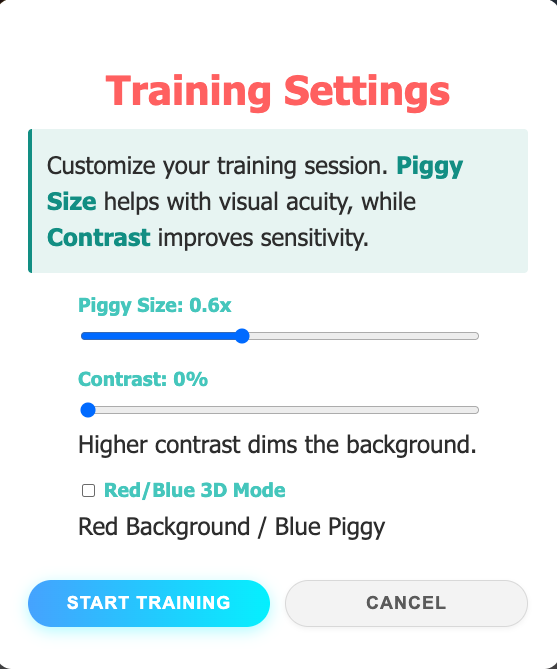
Optional Red/Blue glasses mode for specialized dichoptic training exercises.
Boost short-term memory and visual concentration by finding matching piggy pairs hidden on the board.
A classic Onet-style puzzle that trains spatial awareness and pattern recognition.
Enhance problem-solving skills with this classic sliding tile puzzle featuring cute piggy portraits.
A 2048-style strategic game. Merge piggies to discover higher-level forms and unlock the legendary King Piggy.
Sharpen your mental math skills! Solve addition, subtraction, multiplication, and division puzzles with increasing difficulty levels.
Advance through adventure mode levels and unlock harder challenges.
Unlock special achievement badges for milestones and streaks.
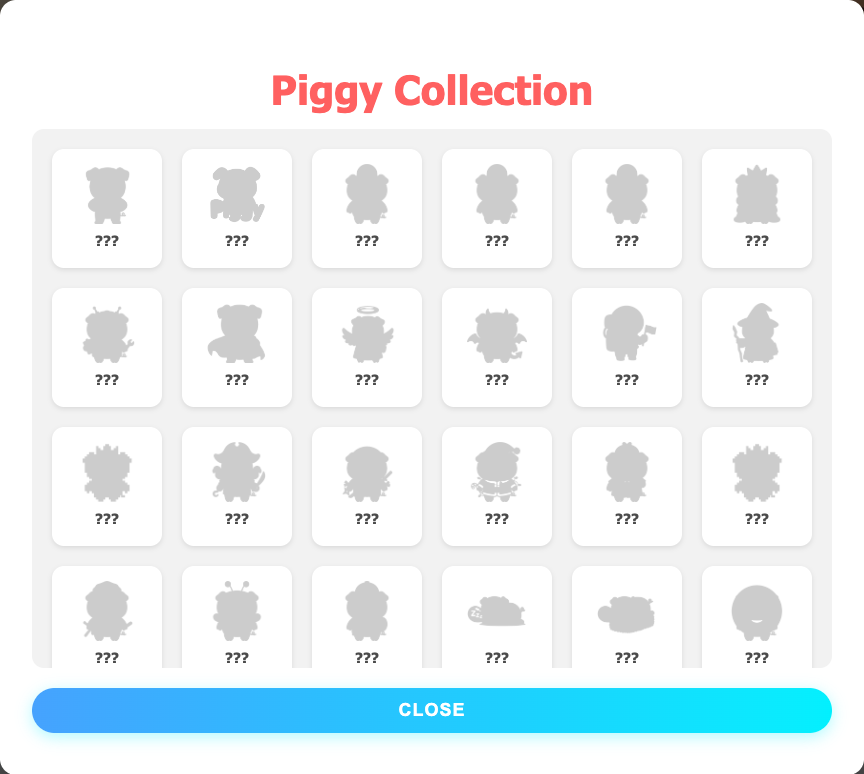
Find and collect all unique piggies in your PiggyDex.
Build a healthy habit with daily training streaks.
Complete 3 fun daily missions to stay motivated and track your training consistency.
Track your development with detailed Reaction Speed and Success Rate metrics.
Add Piggy Peekaboo to your home screen for an immersive full-screen experience. Just like an app, but no download needed! (Note: Internet connection required)
Open in Chrome/Safari
Tap 'Share' or 'Menu'
Select 'Add to Home Screen'

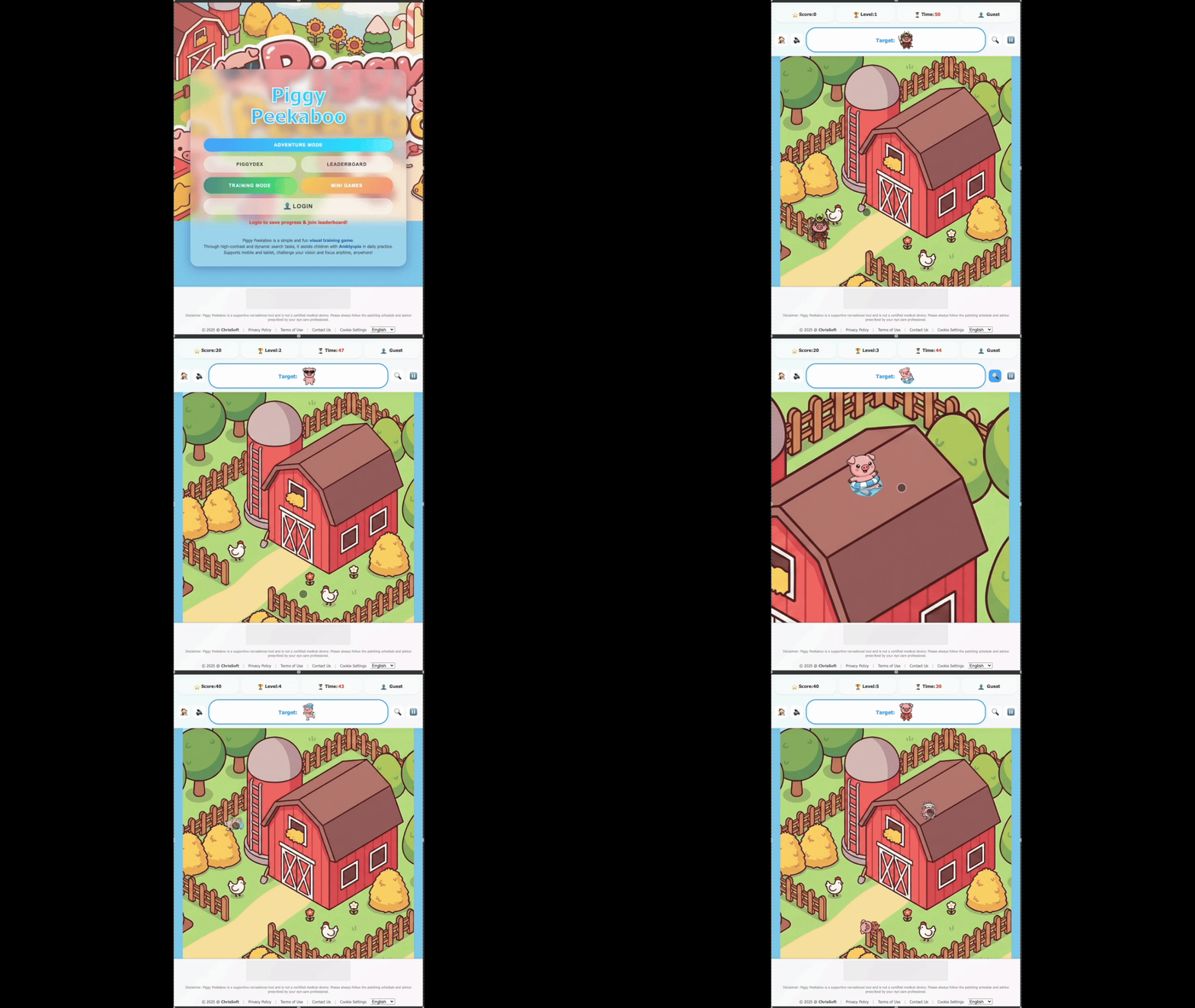
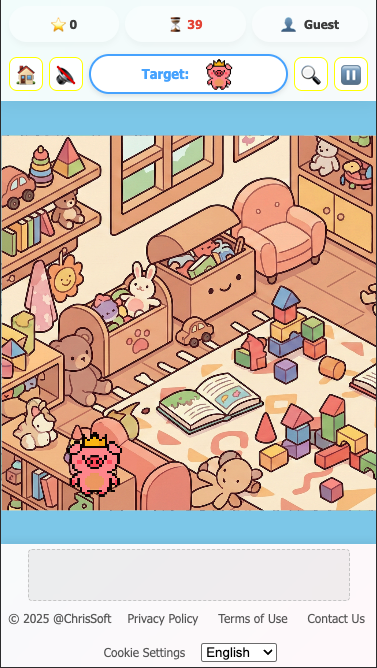
Unlike passively watching cartoons, finding a hidden piggy invites 'active scanning' that keeps young eyes searching and engaged. Vision research into amblyopia highlights why active visual engagement matters.
We use high-contrast palettes and 'crowded' scenes, so play involves telling objects apart from their background, a skill that vision research links to amblyopia.
The act of spotting a target and precisely clicking or tapping it builds essential hand-eye coordination pathways, reinforcing the connection between vision and action.
Level transitions feature decorative Gabor-patch-style animations inspired by patterns studied in vision research.
15-20 minutes per session.
Best played on a Tablet or Desktop (bigger screen is better).
Wear the eye patch on the "good eye" while playing.
Keep 30-40cm distance from the screen.
Amblyopia, also known as lazy eye, is a vision development disorder in which an eye fails to achieve normal visual acuity, even with prescription eyeglasses or contact lenses.
Early detection is key. Look for signs like squinting, shutting one eye, or head tilting. Comprehensive eye exams are recommended at 6 months, 3 years, and before starting school.
Struggling to focus? It might be 'Convergence Insufficiency', not ADHD. Learn how to tell the difference.
Confused between Lazy Eye and Crossed Eyes? Learn the key differences and how to treat them effectively.
???
Classic
???
Rainbow

Sushi

???
Icon
???
Classic
???
Rainbow
Sushi
???
Icon
It is a free, browser-based game designed to support vision therapy for children with Amblyopia (lazy eye). It gamifies the 'patching' time.
Suitable for toddlers (3+) to adults. For young children, we recommend parental guidance to ensure they are scanning actively.
No, you only need an eyepatch to cover the "good eye". The game works on any standard mobile phone, tablet, laptop, or desktop screen.
Please follow the schedule your ophthalmologist prescribes. Families often play in short 15-30 minute sessions during prescribed patching time.
Research on neuroplasticity suggests adults may benefit from consistent visual activity too. Piggy Peekaboo is a supportive practice tool, not a treatment, so ask your eye-care professional what is right for you.
No. Piggy Peekaboo is simply a fun way to pass prescribed patching time, so you must still wear the patch exactly as your doctor directs!
Yes. Piggy Peekaboo can export a visual training report as a PDF — summarizing total practice time, daily trends, success rate, and reaction speed — designed to be printed or shared with your ophthalmologist. It is generated entirely on your device from locally stored data.
Yes. You can follow a guided 4–8 week training plan that automatically adjusts each week — gradually reducing the piggy's size, raising the contrast, and introducing red/blue anaglyph mode — so practice progresses steadily over time.
Yes, in a playful way. A built-in contrast activity shows piggies at progressively lower contrast so you can note the faintest level your child can still spot over time. It is a fun self-check, not a clinical measurement or diagnosis.
Yes. Piggy Peekaboo is completely free with no ads.
No. This is a supportive recreational tool. Always follow the specific medical advice and patching schedule prescribed by your doctor.
The Struggle is Real. We know the tears. We know the battles. Research indicates that adherence to patching therapy can be as low as 50% due to emotional distress and boredom (PEDIG, 2003). Telling a child they must cover their "good eye" for hours every day is heartbreakingly difficult when the alternative is monotonous activities like reading or coloring.
Active vs. Passive. Piggy Peekaboo is built on the principles of Perceptual Learning. Unlike passively watching TV, our game invites active visual engagement: searching, scanning, and focusing. By engaging the child in a task that requires active scanning, discrimination, and rapid focus, the activity is built around active visual scanning and ideas from neuroplasticity research. Recent studies (2023) suggest that gamified and digital approaches may help with treatment adherence.
Joy Meets Progress. Beyond staying 100% free, we strive to create an engaging environment. We want children to want to practice, gaining confidence through achievement and enjoying their progress in the game.
- The ChrisSoft Team
Background research that informs our design. These studies evaluate digital/dichoptic training in general, not Piggy Peekaboo:
 Support us on Ko-fi