The Power of Dichoptic Training: Why Red/Blue Glasses?
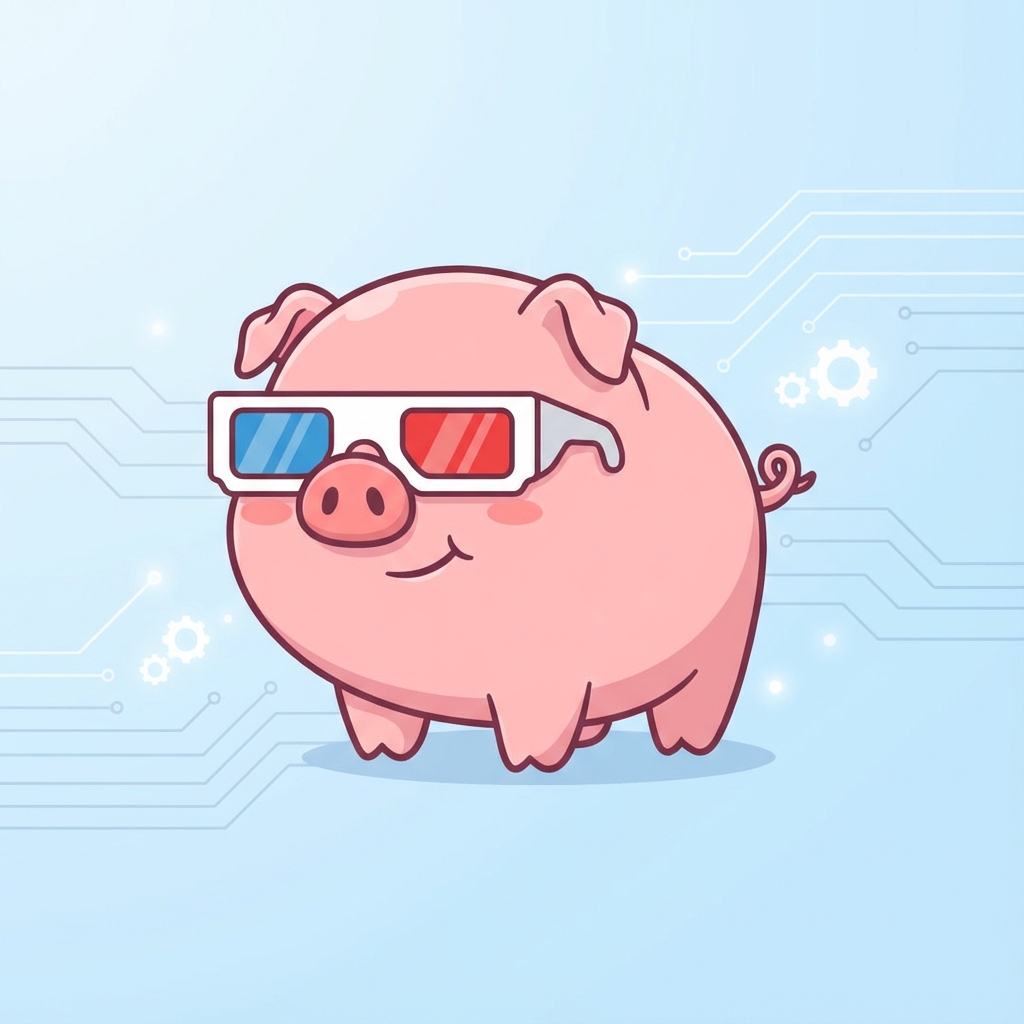
You might remember red and blue glasses from old 3D movies, but did you know researchers also use them to study lazy eye? Let's explore "Dichoptic Training" and the idea of getting both eyes working together.
What is Dichoptic Training?
"Di" (two) + "Optic" (vision). Simply put, it means training both eyes simultaneously but independently.
Traditional patching is "monocular" (one-eyed) training—it forces the lazy eye to work by covering the strong eye. While effective for strengthening vision, it doesn't teach the eyes how to work together as a team. Dichoptic training bridges this gap.
How Red/Blue Mode Works in Piggy Peekaboo
When you enable Red/Blue 3D Mode in the game settings and wear standard anaglyph glasses (Red on Left, Blue on Right):
- The Background turns Red: The Red lens filters this out, so only the Blue eye (usually the good eye) sees the background landscape.
- The Piggy turns Blue: The Blue lens filters this out, so only the Red eye (usually the lazy eye) sees the target.
This creates a unique situation: To find the Piggy within the landscape, your brain MUST combine the images from both eyes. If the lazy eye "shuts off" (suppression), the Piggy disappears. If the good eye shuts off, the world disappears.
Breaking the "Suppression" Habit
The biggest enemy in amblyopia is "suppression." Because the image from the lazy eye is blurry or confusing, the brain actively ignores it. Over time, this becomes a habit.
Dichoptic training is designed to coax the brain into "un-ignoring" the lazy eye. Researchers describe it as something like a gym workout for binocular fusion. Because the game asks for input from both eyes, it offers an engaging, playful way to practice the kind of binocular activity that dichoptic-training research explores.
Is it Better than Patching?
It's not necessarily "better," but it is a complementary approach.
- Patching is great for boosting visual acuity (seeing 20/20) in the lazy eye.
- Dichoptic Training is studied specifically for Binocular Vision and stereo acuity (3D vision), which patching alone does not address.
Many vision therapists recommend a combination of both. Think of patching as lifting weights to build muscle, and dichoptic training as learning to dance or play a sport with that muscle.
How to Get Started
- Get Glasses: You need standard Red/Cyan anaglyph glasses. They are very cheap and available online (Amazon, eBay, etc.).
- Configure Game: Open Piggy Peekaboo, go to "Training Mode", and toggle "Red/Blue 3D Mode".
- Check Eye: In the game, the Piggy is Blue (dark) and the background is Red. The Red lens makes the red background look bright while the Blue Piggy stays dark, so the eye behind the Red lens is the one that sees the Piggy. Put the Red lens over the lazy eye.
Note: If you are unsure which eye should wear which color, try closing one eye at a time. The eye that sees the Piggy clearly against the background is the one doing the work!
Ready to try? Grab a pair of red/blue glasses and switch up your daily routine!
Play NowDichoptic Therapy References
Background research on dichoptic training (these studies examine binocular training in general, not Piggy Peekaboo):
- Antisuppression Therapy: Hess, R. F., Mansouri, B., & Thompson, B. (2010). A binocular approach to treating amblyopia: antisuppression therapy. Optometry and Vision Science, 87(9), 697-704.
- Binocular Game Therapy: Kelly, K. R., Jost, R. M., Dao, L., Beauchamp, C. L., Leffler, J. N., & Birch, E. E. (2016). Binocular iPad Game vs Patching for Treatment of Amblyopia in Children: A Randomized Clinical Trial. JAMA Ophthalmology, 134(12), 1402-1408.