The Science Behind Piggy Peekaboo: The Research That Inspired Its Design
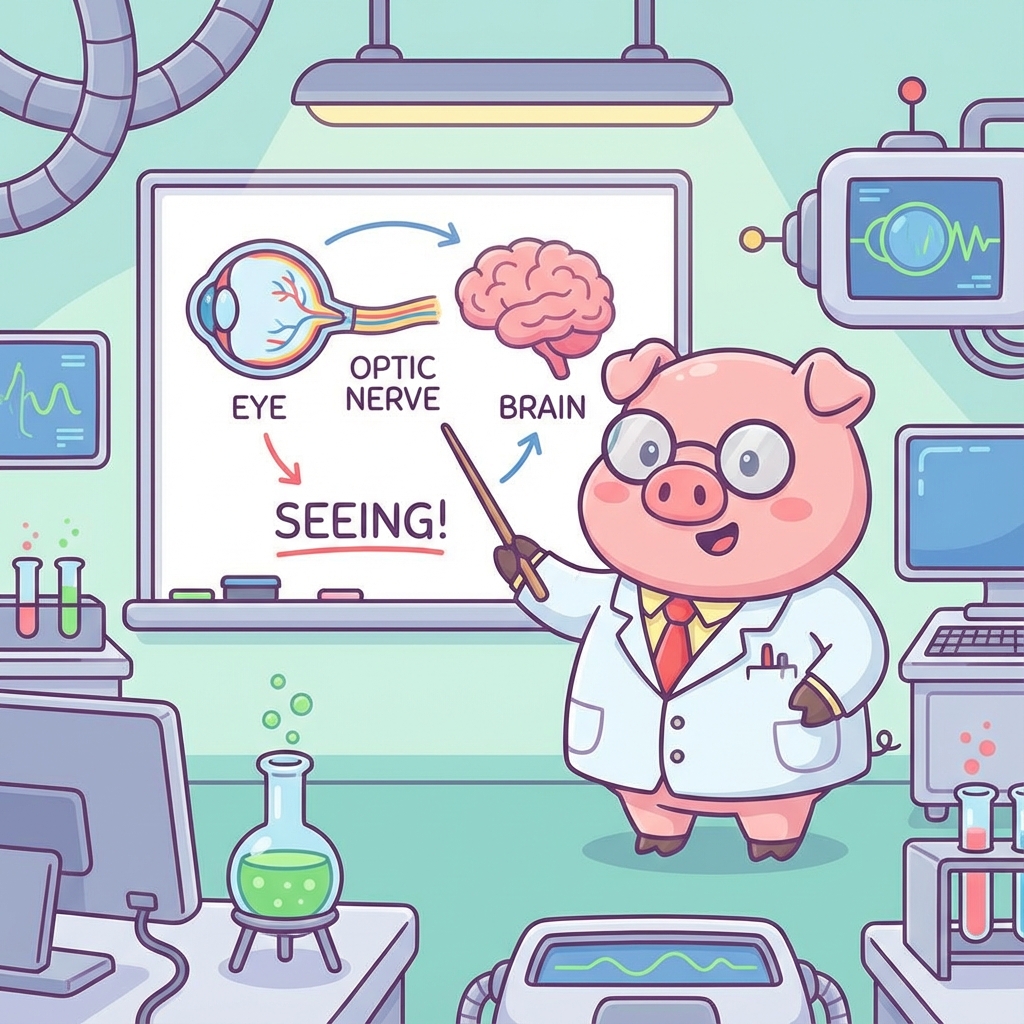
It's not just hide-and-seek. Every design detail in Piggy Peekaboo draws on ideas from neuroscience and vision-therapy research. Let's explore what makes it both fun and engaging.
1. What is a Gabor Patch? (The Whetstone for Neurons)
You may have noticed the blurry striped patterns in the game. Scientifically, these are called Gabor Patches.
A Gabor patch is a sinusoidal grating with a Gaussian envelope. In vision research, Gabor patches are studied as a stimulus for the primary visual cortex (V1); we include this style as a playful nod to that research, not as a treatment.
2. Fighting "Visual Crowding"
Many children with amblyopia suffer from the "Crowding Effect." They can read a single letter clearly, but if that letter is surrounded by other letters or patterns, it becomes a blur.
The core gameplay asks players to find a specific Piggy among distractors (rocks, grass, trees), a "separate the target from a busy background" task. Research into amblyopia describes the "crowding effect" that makes this kind of task interesting to study.
3. Neuroplasticity: The Brain Can Change
In the past, it was believed that vision development had a "critical period" (usually up to age 7-8), after which amblyopia was hard to treat. Modern neuroscience has overturned this.
Neuroplasticity research suggests that even older children and adults have brains capable of change, and that consistent, focused visual practice (perceptual learning) is an active area of study. Piggy Peekaboo offers a fun way to stay consistent.
4. Active Engagement vs. Passive Watching
Parents often ask, "Is watching TV with a patch enough?" The effect is limited because TV is "passive."
The game forces the child to be "active"—searching, judging, and clicking. This "Hand-Eye-Brain" coordination generates much stronger neural signals in the brain. This is why researchers are interested in active, engaging visual tasks rather than passive screen time during patching.
The Science Summary: Piggy Peekaboo draws on ideas from vision research — Gabor-patch-style visuals, "find the piggy" mechanics, and active engagement — to make patching time feel like a fun game rather than a chore.
Scientific References
- Gabor Patches & V1 Activation: Campbell, F. W., & Robson, J. G. (1968). Application of Fourier analysis to the visibility of gratings. The Journal of Physiology, 197(3), 551.
- Perceptual Learning in Amblyopia: Levi, D. M., & Li, R. W. (2009). Perceptual learning as a potential treatment for strabismic amblyopia: A mini-review. Vision Research, 49(21), 2535-2549.
- Video Games & Neuroplasticity: Li, R. W., Ngo, C., Nguyen, J., & Levi, D. M. (2011). Video-game play induces plasticity in the visual system of adults with amblyopia. PLoS Biology, 9(8), e1001135.