Myopia vs. Amblyopia: The Confusion Parents Face
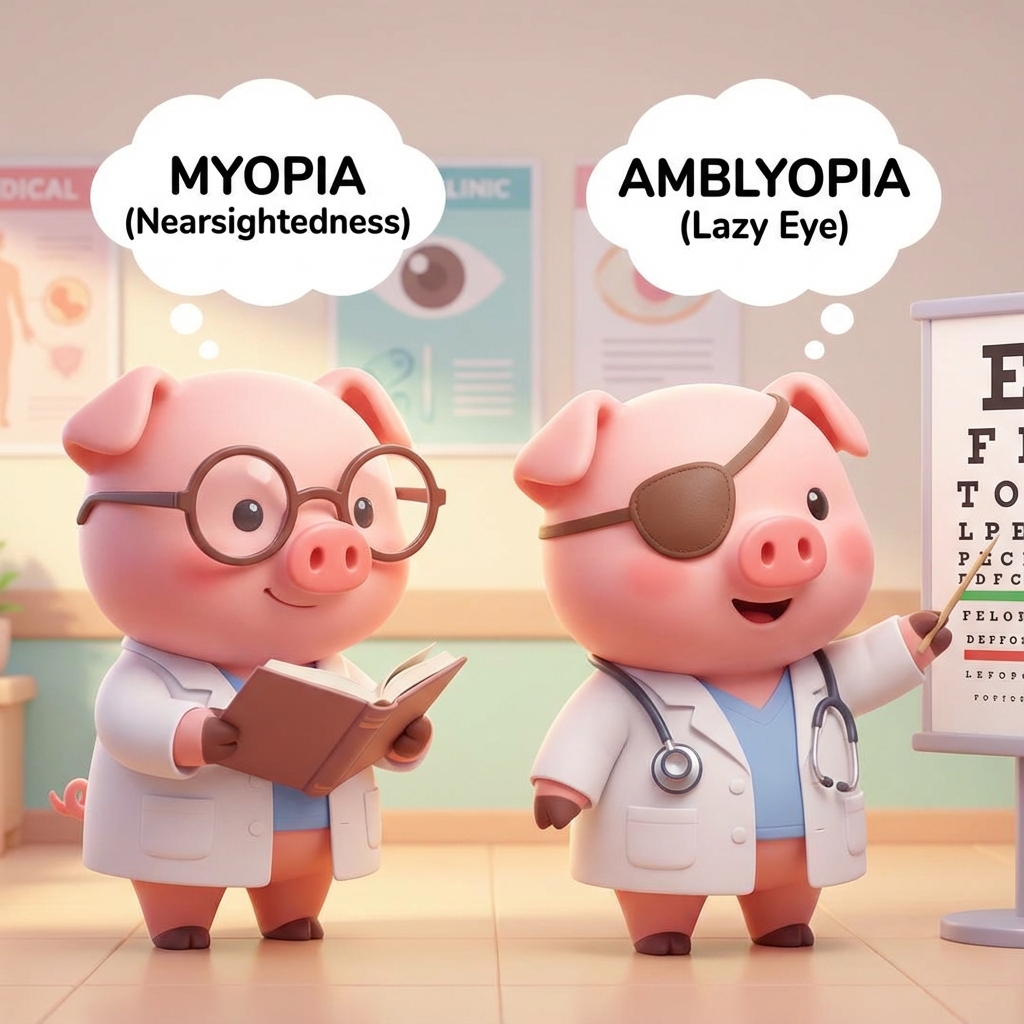
"My child just needs glasses, right?" This is the most common question eye doctors hear. But the answer depends entirely on whether the diagnosis is Myopia (Near-sightedness) or Amblyopia (Lazy Eye). While they both cause blurry vision, they are fundamentally different conditions.
The Hardware vs. Software Analogy
The easiest way to understand the difference is to think of the eye as a camera and the brain as a computer.
- Myopia is a "Lens" Issue (Hardware): The eye is healthy, but the lens focus is off. The image hitting the retina is blurry because of the eye's shape.
- Amblyopia is a "Connection" Issue (Software): The eye might even be structurally perfect (or corrected with glasses), but the cable to the brain is faulty. The brain doesn't know how to process the image from that eye.
1. What is Myopia?
Myopia, or near-sightedness, means objects far away look blurry. It usually happens because the eyeball grows too long.
- The Fix: Glasses or contact lenses act as a correction tool. When a child with myopia puts on glasses, they typically see clearly immediately (20/20 vision).
- Is it curable? No, it's usually progressive (gets worse with age), but it is correctable.
2. What is Amblyopia?
Amblyopia, or Lazy Eye, is a neurodevelopmental disorder. The brain favors one eye and suppresses the other.
- The Fix: Glasses are often the first step, but usually not enough on their own. Even with glasses, the child might still see 20/40 or 20/100 because the brain is still ignoring that eye.
- The Real Work: You need to force the brain to use the weaker eye. This requires Patching (covering the good eye) or active vision therapy games like Piggy Peekaboo.
- Is it curable? Yes, effectively, but mostly during childhood (the "golden period" before age 7-12).
Key Differences at a Glance
| Feature | Myopia (Near-sightedness) | Amblyopia (Lazy Eye) |
|---|---|---|
| Problem Area | Eye Shape / Focus | Brain-Eye Connection |
| Vision with Glasses | Instantly Clear (20/20) | Still Blurry (initially) |
| Primary Treatment | Glasses, Contacts, Atropine | Patching, Vision Therapy, Games |
Can You Have Both?
Yes. In fact, high myopia (or high hyperopia) in one eye is a common cause of amblyopia. If one eye sees perfectly and the other is very near-sighted, the brain may give up on the near-sighted eye, leading to Refractive Amblyopia.
Why Games Help Amblyopia (But Not Myopia)
You can't "exercise" away myopia; the eye shape is physical. But you CAN exercise away amblyopia because it is a brain problem. Active training—like spotting the Piggy while wearing a patch—stimulates the neurons in the visual cortex, strengthening that "weak software connection."
Is your child treating Amblyopia? Make it fun!
Try Piggy PeekabooKey References
- Outdoor Time & Myopia: Morgan, I. G., Ohno-Matsui, K., & Saw, S. M. (2012). Myopia. The Lancet, 379(9827), 1739-1748. (Highlighting the preventive role of outdoor light).
- National Eye Institute (NEI): Amblyopia (Lazy Eye) information page.